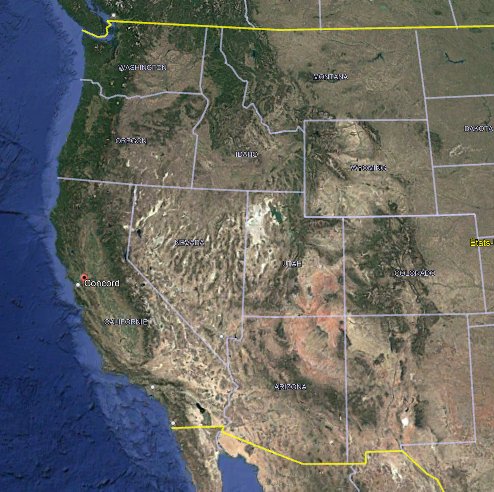
Concord, California, USA, on July 15, 1947:
ACUFO-1947-07-15-CONCORD-1
Journalist Jack Burket wrote chronicles titles "Night and Day" for the newspaper The San Francisco News in the 1940's. On July 18, 1947, this newspaper published his chronicle about the mystery of the flying disks. Burket thought it was about time that the Air Force and the Navy give the solution of the mystery as evidence "piles up that the people haven't been imagining things.
Burket then explained that Colonel Frank A. Flynn, a veteran military airman, lawyer and examiner for the Civil Aeronautics Board, was flying to Sacramento on July 15, 1947 in a Vultee BT-13 airplane.
While over Concord at 4000 feet about 12:15 p.m., he saw what appeared to be a flock of large birds approaching.
Burket quoted Flynn:
"But as they passed me, they took on a different form. They were shaped something like giant birds but they had no necks or tails. There were from a dozen to fifteen of them and they yawed along in a sort of see-saw manner, flying at three different levels down to 3500 feet, and about 200 feet apart."
Using a Taylorcraft that was in the air on his other side as a measuring guide, Colonel Flynn estimated them to be approximately 15 feet across, about the size of the radio-controlled target ship developed by the Navy during the war.
He quickly swung his plane around and took after them but was able only to determine that their speed was "far in excess of 200 miles an hour."
Colonel Flynn said the flying objects were very white on top and, when a thermal tipped a number of them sharply, he was able to see that they were gray and black underneath. There was no place where a pilot could have been seated, he said, and there was no master ship in the sky so far as he could detect. Hes estimated the closest he came to the flying object nearest him was about a mile.
Unfortunately, Flynn did not have a camera in his plane or he could have had a photo of what he saw. From now on he intends to carry one with him at all times, ready to film any other flying object he would come across.
Burket explains that Colonel Flynn is sure of what he saw, and that he is "an observer whose reliability cannot be questioned!"
| Date: | July 15, 1947 |
|---|---|
| Time: | 12:15 p.m. |
| Duration: | ? |
| First known report date: | July 18, 1947 |
| Reporting delay: | 3 days. |
| Country: | USA |
|---|---|
| State/Department: | California |
| City or place: | Concord |
| Number of alleged witnesses: | 1 |
|---|---|
| Number of known witnesses: | 1 |
| Number of named witnesses: | 1 |
| Reporting channel: | The Press. |
|---|---|
| Visibility conditions: | Day. |
| UFO observed: | Yes. |
| UFO arrival observed: | ? |
| UFO departure observed: | Yes. |
| UFO action: | Flew in formation. |
| Witnesses action: | Observed, turned to try to approach. |
| Photographs: | No. |
| Sketch(s) by witness(es): | No. |
| Sketch(es) approved by witness(es): | No. |
| Witness(es) feelings: | ? |
| Witnesses interpretation: | ? |
| Sensors: |
[X] Visual: 1.
[ ] Airborne radar: N/A. [ ] Directional ground radar: [ ] Height finder ground radar: [ ] Photo: [ ] Film/video: [ ] EM Effects: [ ] Failures: [ ] Damages: |
|---|---|
| Hynek: | DD |
| Armed / unarmed: | Unarmed. |
| Reliability 1-3: | 2 |
| Strangeness 1-3: | 3 |
| ACUFO: | Probable extraterrestrial craft. |
[Ref. sfn1:] NEWSPAPER "THE SAN FRANCISCO NEWS":
|
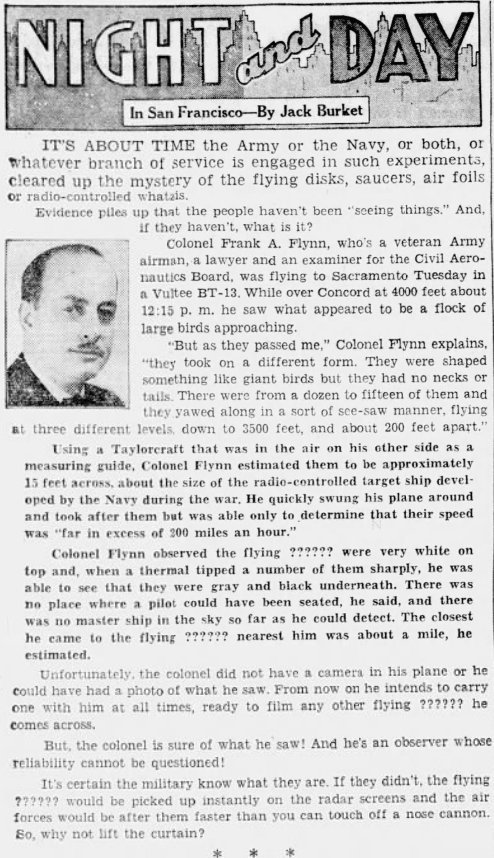
IT'S ABOUT TIME the Army or the Navy, or both, or whatever branch of service is engaged in such experiments, cleared up the mystery of the flying disks, saucers, air foils or radio-controlled whatzis.
Evidence piles up that the people haven't been "seeing things." And, if they haven't, what is it?
Colonel Frank A. Flynn, who's a veteran Army airman, a lawyer and an examiner for the Civil Aeronautics Board, was flying to Sacramento Tuesday in a Vultee BT-13. While over Concord at 4000 feet about 12:15 p. m. he saw what appeared to be a flock of large birds approaching.
"But as they passed me," Colonel Flynn explains, "they took on a different form. They were shaped something like giant birds but they had no necks or tails. There were from a dozen to fifteen of them and they yawed along in a sort of see-saw manner, flying at three different levels down to 3500 feet, and about 200 feet apart."
Using a Taylorcraft that was in the air on his other side as a measuring guide, Colonel Flynn estimated them to be approximately 15 feet across, about the size of the radio-controlled target ship developed by the Navy during the war. He quickly swung his plane around and took after them but was able only to determine that their speed was "far in excess of 200 miles an hour."
Colonel Flynn observed the flying ???? were very white on top and, when a thermal tipped a number of them sharply, he was able to see that they were gray and black underneath. There was no place where a pilot could have been seated, he said, and there was no master ship in the sky so far as he could detect. The closest he came to the flying ???? nearest him was about a mile, he estimated.
Unfortunately, the colonel did not have a camera in his plane or he could have had a photo of what he saw. From now on he intends to carry one with him at all times, ready to film any other flying ???? he comes across.
But, the colonel is sure of what he saw! And he's an observer whose reliability cannot be questioned!
It's certain the military know what they are. If they didn't, the flying ???? would be picked up instantly on the radar screens and the air forces would be after them faster than you can touch off a nose cannon. So, why not lift the curtain?
[Ref. tbr1:] TED BLOECHER:
Ted Bloecher indicated that a sighting on July 15, 1947, in Concord, California, reported by San Francisco News columnist Jack Burket, was made by an observer with impressive qualifications: Colonel Frank A. Flynn, a veteran Army airman, a lawyer, and an examiner for the Civil Aeronautics Board. He was flying from San Francisco to Sacramento in a Vultee BT-13 when, at 12:15 p.m. PST, over Concord, he saw what he first thought was a flock of large birds heading towards him.
Bloecher quotes:
"But as they passed me, they took on a different form. They were shaped something like giant birds but they had no necks or tails. There were from a dozen to fifteen of them and they yawed along in a sort of see-saw manner, flying at three different levels, down to 3,500 feet, and about 200 feet apart."
Colonel Flynn estimated their size as about 15 feet across. He swung his plane around in pursuit of the objects, but they quickly outdistanced him qith a speed "far in excess of 200 miles an hour," according to the pilot.
Flynn described the objects as being very white on top and when they flipped he was able to see they were grey and black underneath. Colonel Flynn said there was no place where a pilot could have been seated. At their closest point, Flynn estimated them to be about a mile away. They reminded him of the radio-controlled target ships developed by the Navy during the war, and although he looked for one, Flynn could not see any master ship in the area.
[Ref. lhh1:] LARRY HATCH:
1160: 1947/07/15 12:20 2 122:02:00 W 37:58:00 N 3333 NAM USA CLF 7:7
CONCORD,CA:CAA PILOT:12-15 5M OBJS/GROUPS:200mph >W::ODD BOOMERANG/SF NEWS
Ref#187 BLOECHER, Ted: REPORT/UFO WAVE of 1947 Case No. 841: IN-FLIGHT
[Ref. get1:] GEORGE M. EBERHART:
July 15 [1947] - 12:15 p.m. Col. Frank A. Flynn is flying a Vultee BT-13 Valiant over Concord, California, when a group of 12-15 objects approaches and passes him. At first he takes them for birds, but he can see no necks or wings and they are moving in excess of 200 mph. They are moving in a see-saw fashion at three different altitudes about 200 feet apart, and they appear to be about 15 feet across, white on the top and gray and black on the bottom. At their closest point, they are about one mile away. Flynn turns his plane around to pursue them, but they outdistance him quickly. (Bloecher, p. III-13)
[Ref. sfn2:] NEWSPAPER "SAN FRANCISCO NEWS" - JAN ALDRICH - PROJECT 1947:
IT'S ABOUT TIME the Army or the Navy, or both, or whatever branch of service is engaged in such experiments, cleared up the mystery of the flying disks, saucers, air foils or radio-controlled whatzis.
Evidence piles up that the people haven't been "seeing things." And, if they haven't, what is it?
Colonel Frank A. Flynn, who's a veteran Army airman, lawyer and an examiner for the Civil Aeronautics Board, was flying to Sacramento Tuesday in a Vultee BT-13. While over Concord at 4,000 feet about 12:15 p.m. he saw what appeared to be a flock of large birds approaching.
"But as they passed me," Colonel Flynn explains, "they took on a different form. They were shaped something like giant birds but that had no necks or tails. They were from a dozen to fifteen of them and they yawed along in a sort of see-saw manner, flying at three different levels, down to 3500 feet, and about 200 feet apart."
Using a Taylorcraft that was in the air on his other side as a measuring guide, Colonel Flynn estimated them to be approximately 15 feet across, about the size of the radio-controlled target ship developed by the Navy during the war. He quickly swung his plane around and took after them but was able only to determine that their speed was "far in excess of 200 miles an hour."
Colonel Flynn observed the flying ?????? were very white on top and, when a thermal tipped a number of them sharply, he was able to see that they were gray and black underneath. There was no place where a pilot could have been seated, he said, and there was no master ship in the sky so far as he could detect. The closest he came to the flying ?????? nearest him was about a mile, he estimated.
Unfortunately, the colonel did not have a camera in his plane or he could have had a photo of what he saw. From now on he intends to carry one with him at all times, ready to film any other flying ?????? he comes across.
But, the colonel is sure of what he saw! And he's an observer whose reliability cannot be questioned!
It's certain the military know what they are. If they didn't, the flying ?????? would be picked up instantly on the radar screens and the air forces would be after them faster than you can touch off a nose cannon. So, why not lift the curtain?
[Ref. wia1:] "WIKIPEDIA" (EN):
| Report publish date | Location | Date of claimed sighting | Names | Notes | Bloecher # |
| Jul 18 | Concord, California | Jul 15 | Col Frank A Flynn (563) | #841 | |
| Jul 21 | Concord, California | Jul 15 | Col Frank A Flynn (564) | #842 |
The case was listed twice; sources are said to be: "563 San Francisco News, July 18, 1947"; "564 Boise Daily Statesman (UP, Idaho Falls), July 21, 1947". The second source says nothing of this case.
.The Vultee BT-13 "Valiant" (photo below) was an American basic training aircraft of World War II built for the U.S. Army Air Corps. After the war, a large number of them were decommissioned and sold to civilian pilots for a few hundred dollars apiece.

|
|
The similarities in the report with the report by Kenneth Arnold on June 24, 1947, are quite striking.
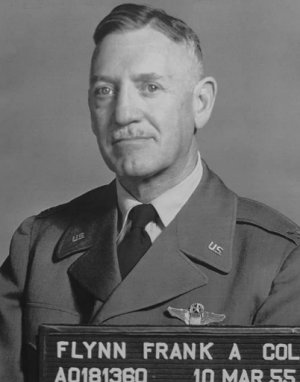
The 1947 Press confirms that Frank A. Flynn (1955 photo below) was then a lawyer, and an examiner for the Civil Aeronautics Asdministration.
|
Military records and civilian records and the usmilitariaforum.com webiste indicate that Frank A. Flynn was born in San Francisco, California, on May 21, 1896. As a student he became a candidate in training for a commission at the training camp at Presidio, San Francisco and the school of Military Aeronautics, Berkeley, California from 15th May to 25th July 1917. He had been appointed a 2nd Lieutenant while undertaking this training on 4th June with the Cavalry Officers Reserve Corps, however he was relieved from active duty on 14th August by reason of resignation and he enlisted with the Aviation Signal Reserve Corps the following day. On 13th September he was honourably separated by reason of his services being no longer required. Not to be deterred, he then made his way to Canada where he enlisted with the Canadian Royal Flying Corps at Toronto on 2nd October. He was appointed a 3rd Air Mechanic, and on 1st February 1918 he was discharged to accept a commission with the Royal Flying Corps. He was retained in Canada as a Flying instructor with the 85th Training Squadron, however at the end of February he was granted 4 weeks sick leave and he returned home. On 3rd March, while at Tallaferro field, Fort Worth, Texas he took an air cadet from Los Angeles on a flight and when 400 feet from the ground the machine went into a tailspin. The controls refused to work, and the machine started to drop. Their aircraft struck the ground in a newly ploughed field which may have saved their lives, the air cadet, who was in the front seat, received a broken arm and two broken ribs, while Frank received a broken nose. After his leave had expired, he embarked for England where he served with the 33rd Training Squadron, 20th Bristol Fighter Squadron in France and then he volunteered for service in Russia. In the California Honour roll, War History Department of the First World War, Frank describes his time with the Royal Flying Corps / Royal Air Force, including in Russia:
"My work consisted partly in chasing down submarines on the East Coast of England, the work was rather monotonous except for the stray Hun patrol or Zep, and through our vigilance, we kept these rather scarce. Later I went to France and my work consisted of escorting Bombers, which I was just getting warmed up to, when the armistice was declared. I then answered the call for volunteers to Russia and we certainly worked hard up there, bombing the Bolshevik positions and dumps and doing considerable artillery observation for the Army and Navy, it was for my good work along this line that I received the Russian Order of St Anne, 3rd class with crossed swords. While observing some gun positions, I stopped a machine gun bullet through my leg, thus concluding my war in Russia."
Returned in the USA, in San Francisco, he resumed his legal studies and on 6th July 1923 he enlisted with the United States Army Air Corps Reserve where he was appointed a 2nd Lieutenant and allocated service number 0181360. He was rated at Junior Aircraft Pilot on 2nd June 1925, and he received promotion to 1st Lieutenant on 12th June 1926.
He served as Superintendent of the San Francisco airport and the Northern California coordinator for Civil Defence at the beginning of WWII, and on 18th May 1942 he was appointed a Major with the Army of the United States (AUS) from the Officer Reserve Corps. He was ordered to report for duty with the Air Force Combat Command for limited service only.
Due to limitation of movement caused by WWI wounds, he was limited to flight duties in continental United States with a non-tactical organization. In 1947 or 1948, he had a total of 3365 hours and 45 minutes flying time.
He had the US and British Victory Medals, British War Medal and the Russian Order of St Ann and he served with 413th Base Headquarters, Tonopah, Nevada where he was promoted to the rank of Lt-Colonel on 22nd June 1943. In 1944 he served with 461st American Air Force Base, San Francisco, California and 464th American Air Force Base McChord Field, Washington D.C, as executive officer. After the ending of the Second World War his appointment with the Army ended. He was relieved from active service on 3rd March 1945, and he was re-appointed to the United States Air Force Reserve.
On 22nd July 1949 he was promoted to the rank of Colonel and he held a number of senior positions at the Hamilton Air Force Base in California till he was disqualified from Flying Duties on 29th August 1955 as physically unfit. He retired from the United States Air Force Reserve not long after on 31st January 1956 after 32 years' service. After retiring from Military Life, he served as a commissioner for the Superior Court. He was active for many years in civic affairs and served as president of the War Memorial Board of Trustees.
Frank A. Flynn died from heart disease at the age of 84 at the Greenbrae Convalescent Hospital, San Rafael, California on 12th April 1980.
Probable extraterrestrial craft.
* = Source is available to me.
? = Source I am told about but could not get so far. Help needed.
| Main author: | Patrick Gross |
|---|---|
| Contributors: | None |
| Reviewers: | None |
| Editor: | Patrick Gross |
| Version: | Create/changed by: | Date: | Description: |
|---|---|---|---|
| 0.1 | Patrick Gross | June 23, 2026 | Creation, [sfn1], [tbr1], [lhh1], [get1], [sfn2], [wia1]. |
| 1.0 | Patrick Gross | June 23, 2026 | First published. |