
The index page for the 1954 French flap section of this website is here.
In 1954, in France:
Reference for this case: 54-Bcd1.
Please cite this reference in any correspondence with me regarding this case.
Semaine du Monde magazine of November 5-11, 1954, published an article on the activities and observations of Jacques Baccard and his research group on "flying saucers," affiliated with Jimmy Guieu and his "International Commission of Inquiry for the Study of Flying Saucers and Related Problems."
Among other observations made by this group, it was mentioned that "recently," they had noted the presence of a luminous object moving across the sky at a speed that did not correspond to no previously known device, and was silhouetted "on the celestial body" (?).
The magazine indicated that witnesses thought the craft, which was moving in the same direction as the Earth's rotation and emitted no light (!), could have been an artificial satellite.
[Ref. sme1:] "SEMAINE DU MONDE" MAGAZINE:
|
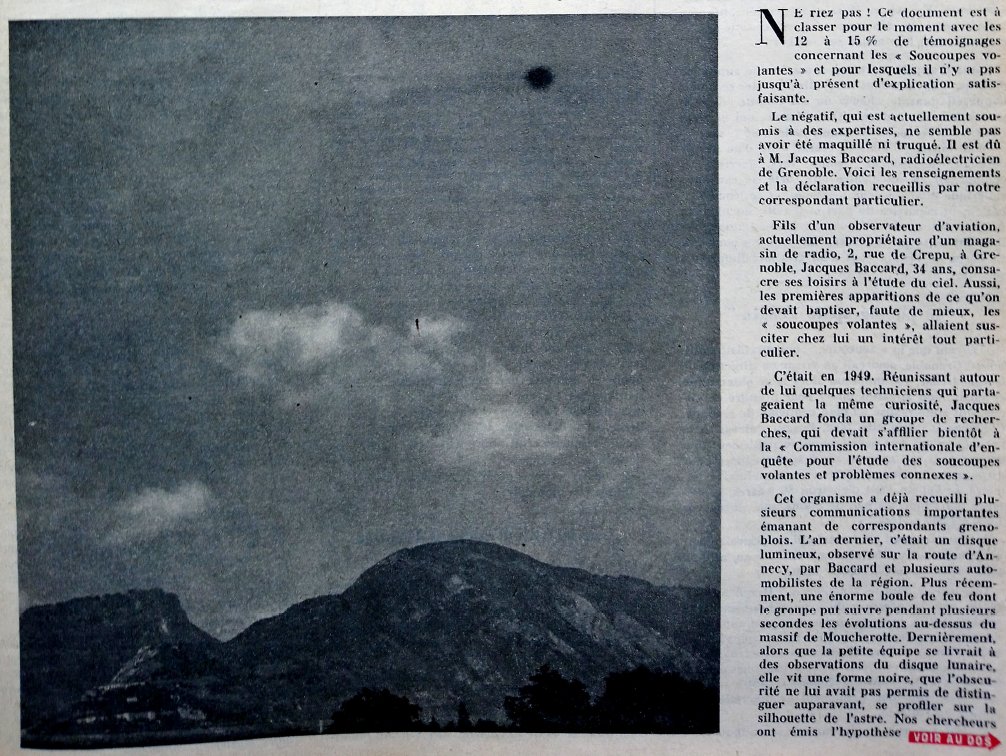
Do not laugh! This document is to be classified for the moment with the 12 to 15% of testimonies concerning "flying saucers" for which there is, up to now, no satisfactory explanation.
The negative, which is currently undergoing expert analysis, does not appear to have been altered or faked. It belongs to Mr. Jacques Baccard, radio technician from Grenoble. Here is the information and the statement collected by our special correspondent.
The son of an aviation observer, and currently the owner of a radio shop at 2, rue de Crepu, in Grenoble, Jacques Baccard, 34, devotes his leisure time to the study of the sky. Thus, the first appearances of what had to be called, for lack of a better term, "flying saucers," aroused a very particular interest in him.
It was in 1949. Bringing together around him a few technicians who shared the same curiosity, Jacques Baccard founded a research group, which was soon to affiliate with the "International Commission of Inquiry for the Study of Flying Saucers and Related Problems."
This organization has already collected several important reports from correspondents in Grenoble. Last year, it was a luminous disc, observed on the road to Annecy by Baccard and several motorists heading to the station. More recently, there was a red point that could be followed for several seconds above the sky over the Moucherotte massif. Lately, the Grenoble group had also noted the presence of a luminous object moving in the sky at a speed that did not correspond to any known craft at the time, silhouetted against the outline of the star. Our researchers have put forward the hypothesis
SEE OVERLEAF
|
|
that the craft, which was moving in the same direction as the Earth's rotation and emitted no light, could have been an artificial satellite.
Encouraged by these various observations, Baccard and his friends decided to tempt fate by multiplying systematic observations of the sky.
On Friday, September 24, Jacques Baccard was on the balcony of his villa on the road to Eybens in the suburbs of Grenoble, which he had turned into a true little observatory. Set up with his measuring boards and the two high-caliber telescopes used for the group's work, he kept within reach the camera he always had ready in such cases. Lulled by the last warmth of the fine season, the city stretched out at the observer's feet was at the hour of the after-dinner drink when the "thing" occurred, which explains the small number of witnesses.
"It was exactly 6:10 p.m.," recounts Jacques Baccard, "when my gaze was drawn to a silhouette that had just appeared in the gap formed by the Isère valley at the exit of Grenoble, between the Vercors massif and the Chartreuse. At first, I took the thing for a plane. This route is in fact the one used by aircraft coming from the north to approach the Grenoble airfield.
"Barely fifteen seconds had passed when the craft was already approaching the outskirts of Grenoble. Intrigued by this fantastic speed, as well as by the fact that the movement was accompanied by no engine noise, I aimed the smaller of my telescopes at it. At the same time, the craft, which was then above the city, made a sudden acceleration, followed by a strong burst of light similar to the glow of an electric arc. Moreover, it left behind it a light gray trail, darker along its central axis, and faintly luminous on the edges.
"Having called my mother and my wife to join me, I kept the craft in the field of my telescope (which has a magnification of twenty) for about ten seconds. Its shape, which first appeared to me in perspective as spindle-shaped - or like a cigar - was in reality that of a disc becoming slightly ovoid toward the rear and having in its center a sort of spherical fuselage whose two hemispheres were equally divided above and below the plane of the disc. Around it was a halo of intense light which made its edges indistinct. The body of the craft was a very dark metallic gray.
"Seeing that the 'saucer,' which was now flying over Grenoble, was beginning a turn toward the Chartreuse, I abandoned my observation and grabbed my camera to take this picture, which was taken at 1/500th of a second. A few moments later, the craft rose vertically, in a truly lightning-fast acceleration. It took about six to seven seconds to disappear from view. According to my calculations, the diameter of the craft was about 80 meters, its distance from me about 2 km, its altitude between 1,000 and 1,200 meters."
Jacques Baccard is categorical: it could not have been a weather balloon, a flight of birds, or any known atmospheric phenomenon.
What should we think of such a testimony? Among all the accounts that the press publishes daily, it seems to be one of those that appear to show seriousness and good faith. In fact, most of the most interesting statements never see the light of day; they are sent to scientific organizations or to newspapers like ours by correspondents who request discretion for fear of ridicule.
Totally insufficient information.
The magazine took no care in writing the article; the object seen is first described as luminous, then as "emitting no light," and as for the "celestial body" against which it is silhouetted, one can only assume that the magazine is referring to the moon.
The witnesses' assumption that it could have been an artificial satellite suggests they were not entirely fixated on "extraterrestrial" explanations, but it doesn't hold water. The first artificial satellite, Sputnik, was only put into orbit in October 1954.
(These keywords are only to help queries and are not implying anything.)
France, Jacques Baccard, object, luminous
[----] indicates sources that are not yet available to me.
| Version: | Created/Changed by: | Date: | Change Description: |
|---|---|---|---|
| 1.0 | Patrick Gross | April 27, 2025 | First published, [sme1]. |

