Clay Center, Kansas, USA, on July 6, 1947:
ACUFO-1947-07-06-CLAYCENTER-1
In the archives of the U.S. Air Force is a report of an observation dated July 6, 1947, collected from a witness on July 16, 1947. The witness was a military pilot, Major Archie B. Browning.
While flying at 13:45 in a B-25 bomber from Ogden, Utah, to Kansas City, Missouri, USA, approximately 100 miles west of Kansas City at an altitude of 10,000 feet, he noticed a very bright object down and to his left, about 10 miles from his aircraft.
His first impression was that it was the top of a water tank. He checked his aircraft's position, which took about 5 seconds, then looked again to his left, and he then saw a round, disc-shaped, very bright silvery object that appeared to be flying 1 to 2 miles off his left wing, at the 11 o'clock position, at 11,000 feet altitude.
The brightness of the object was very intense. The object's diameter was estimated between 30 and 50 feet. It was moving in the same direction and at the same speed of 210 miles per hour as the observer's aircraft.
However, when the pilot began to turn toward the object, it completely disappeared. The weather conditions at the time of the sighting were "CAVU", a military term meaning perfect visibility.
Despite various public announcements in the press stating that the U.S. Air Force was investigating these widely reported phenomena at the time, it apparently did nothing regarding this observation, which was only mentioned again on January 5, 1949, in an internal letter from the "Sign" program, responsible for the collection, investigation, and interpretation of data related to unidentified flying object sightings, listing by case number sightings of unidentified flying objects considered to have "the highest probability of being balloons", including this one.
At the time of its new "Grudge" program, which succeeded "Sign", the Air Force had appointed astronomer Joseph Allen Hynek as a consultant; he was supposed to review past and future cases and find "astronomical explanations" (misidentifications of celestial bodies) where applicable.
Hynek wrote a brief case analysis based solely on the original 1947 report, noting that there was no astronomical explanation for this case. However, Hynek noted that since the object was approximately opposite the position of the sun at that time, he thought - though it was not proven - that the object could have been a direct reflection of the sun "on a continuous object - thin clouds, ice crystals, or something similar".
Hynek then made an error in interpreting the report, which led to his explanation: the pilot had said he "checked his position" for about 5 seconds, during which he obviously was not looking at the object. When he looked again, it was no longer below the aircraft but above it. Hynek, who was not an aviator, clearly understood "his position" as the position of the object, whereas the pilot had been checking the position of his aircraft. Because of this misunderstanding, Hynek believed there was a "contradiction" casting doubt on the report: the pilot would have seen the object below, but when he "checked its position", it would have been above. What the report actually indicates is quite different: the object had climbed.
Instead, Hynek concluded that the object had either been low or high, and that if it was high it could have been a reflection of the sun on a cloud "or something similar", and if it was low it could have been a reflection of the sun "glinting" off a railway track or a river.
The Air Force then listed the case evaluation as: "Astro (SUN REFLECTIONS)".
(Over the years, Dr. Hynek, initially completely skeptical and unmotivated, would completely change his opinion on UFOs and become one of the founders of civilian ufology in the United States.)
The case, in the form of summaries of the original 1947 report, entered ufological literature from 1977 onward, when the Freedom of Information Act (FOIA) came into effect and microfilmed U.S. Air Force archives became accessible to researchers at the National Archives and Records Administration in Washington, D.C.
The complete official documents, including the Air Force's explanations for this case that I present here, were compiled and made available online by researcher Dan Wilson for The NICAP Website in the 2000s.
| Date: | July 6, 1947 |
|---|---|
| Time: | 01:45 p.m |
| Duration: | ? |
| First known report date: | July 16, 1947 |
| Reporting delay: | Hours, 10 days. |
| Country: | USA |
|---|---|
| State/Department: | Kansas |
| City or place: | Clay Center |
| Number of alleged witnesses: | 1 or more. |
|---|---|
| Number of known witnesses: | 1 |
| Number of named witnesses: | 1 |
| Reporting channel: | Official documents, FBI and US Air Force. |
|---|---|
| Visibility conditions: | Day, excellent visibility. |
| UFO observed: | Yes. |
| UFO arrival observed: | ? |
| UFO departure observed: | Yes. |
| UFO action: | Goes up, flies with plane, disappears when plane directed at it. |
| Witnesses action: | Observed, veered towards UFO. |
| Photographs: | No. |
| Sketch(s) by witness(es): | Maybe. |
| Sketch(es) approved by witness(es): | Maybe. |
| Witness(es) feelings: | ? |
| Witnesses interpretation: | First thought water tank on ground. |
| Sensors: |
[X] Visual: 1 or more.
[ ] Airborne radar: N/A. [ ] Directional ground radar: [ ] Height finder ground radar: [ ] Photo: [ ] Film/video: [ ] EM Effects: [ ] Failures: [ ] Damages: |
|---|---|
| Hynek: | DD |
| Armed / unarmed: | Not reported, maybe. |
| Reliability 1-3: | 3 |
| Strangeness 1-3: | 2 |
| ACUFO: | Possible extraterrestrial craft. |
[Ref. aaf1:] U.S. AIR FORCE - PROJECT SIGN ARCHIVE:
|
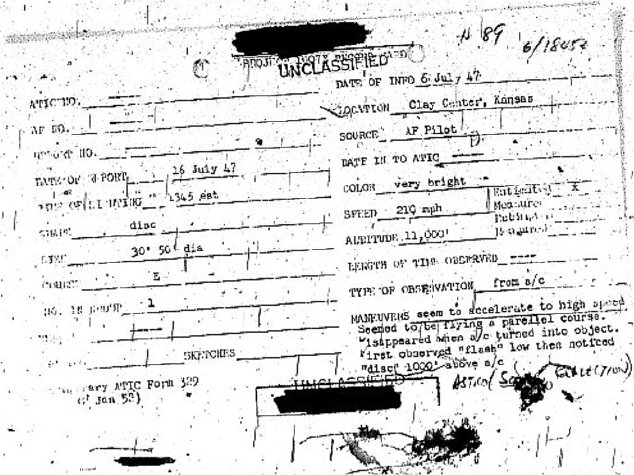
UNCLASSIFIED
DATE OF INFO 6 July 47
LOCATION: Clay Center, Kansas
SOURCE: AF Pilot
DATE IN TO ATIC:
COLOR: very bright
SPEED: 21 mph Estimated
ALTITUDE: 11,000 Estimated
LENGTH OF THE OBSERVED:
TYPE OF OBSERVATION: from a/c
MANEUVERS: seem to accelerate to high speed. Seemed to be flying a parallel course. Disappeared when a/c turned to object. First observed "flash" low then noticed "disc" 1000 above a/c.
ATIC No.:
AF NO:
? NO:
DATE OF REPORT: 16 July 47
SHAPE: disc
SIZE: 30" 50" dia.
COURSE: E
NO. [of objects]: 1
[]: SKETCHES
Summary ATIC Form 329 [?] Jan 52)
|
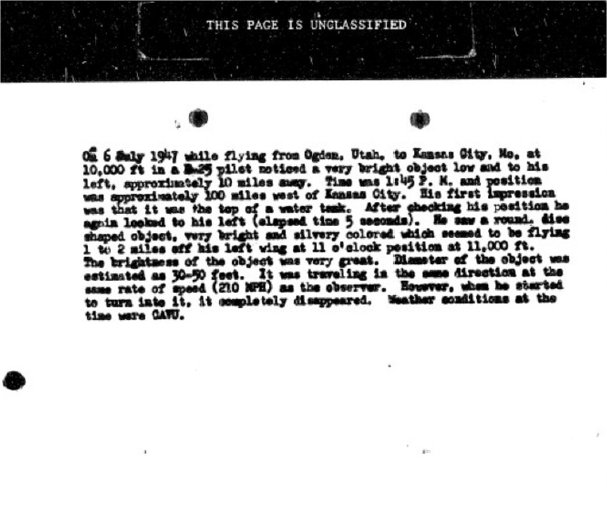
THIS PAGE IS UNCLASSIFIED
On 6 July 1947 while flying from Ogden, Utah, to Kansas city, Mo, at 10,0000 ft in a B-25, pilot noticed a very bright object low and to his left, approximately 10 miles away. Time was 1:45 P.M. and position was approximately 100 miles west of Kansas City. His first impression was that it was the top of a water tank. After checking his position he again looked to his left (elapsed time 5 seconds). He saw a round, disc shaped objet, very bright and silvery colored which seemed to be flying 1 to 2 miles off his left wing at 11 o'clock position at 11,000 ft.
The brightness of the object was very great. Diameter of the object was estimated as 30-50 feet. It was traveling in the same direction at the same rate of speed (210 MPH) as the observer. However, when he started to turn into it, it completely disappeared. Weather conditions at the time were CAVU.
|
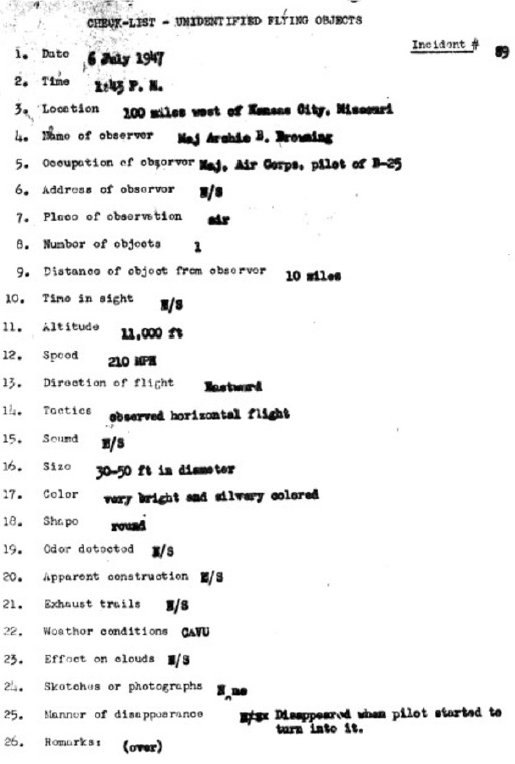
CHECK-LIST - UNIDENTIFIED FLYING OBJECT
Date: 6 July 1947
Time: 1.43 P.M.
Location: 100 miles west of Kansas City, Missouri
Name of observer: Maj. Archie B. Browning
Occupation of observer: Maj. Air Corps, pilot of B-25
Address of observer: N/S
Place of observation: air
Number of objects: 1
Distance of object from observer: 10 miles
Time in sight: N/S
Altitude: 11,000 ft
Speed: 210 MPH
Direction of light: Westward
Tactics: observed horizontal flight
Sound: N/S
Size: 30-50 ft in diameter
Color: very bright and silvery color
Shape: round
Odor detected: N/S
Apparent construction: N/A
Sketches or photographs: N ms
Manner of disappearance: Disappeared when pilot started to turn into it.
Remarks: (over)
This letter by Project "Sign" indicates that as of January 5, 1949, this US Air Force Project missioned to investigate and explain UFO sighting reports estimated that this case (case 89) was among those cases having "the greatest possibility of being balloons:"
THIS PAGE IS UNCLASSIFIED
HEADQUARTERS
AIR MATERIAL COMMAND
Wright-Patterson Air Force Base
Dayton, Ohio
MCIAXO-3/HWS/rm [=Lt. Howard W. Smith]
Jan 5 1949
MCIAXO
SUBJECT: Project "SIGN"
T: Chef, Air Weather Service,
Andrews Air Force Base,
Washington 25, D.C.
ATTN: DSS
1. Project "SIGN" is responsible for the collection, investigation and interpretation of data relative to sighting of unidentified flying objects. Attached Incident Summaries 1 thru 72 from the files of Project "SIGN" are forwarded for study and recommendations as to which of the incidents may be eliminated as balloons released on routine synoptics ascents by the Ait Weather Service, the Navy aerological Service or the United States Weather Bureau. The summaries attached may be retained in your headquarters for working and reference purposes.
2. The Air Weather Service in the only agency of its type that had been asked to assist in the accomplishment of Project "SIGN" except that the United States Weather Bureau has provided information on ball lightning. Research projects in which balloons are used and which are conducted or sponsored by the Army, Navy, or United States Air Force are checked by the Intelligence Department of this Command. These checks are usually made direct from the Project "SIGN" Office, MCIAXO-3. These checks are distinct from the checks of synoptic balloon flights made by weather service stations of the Air Force, the Navy and the Department of Commerce (U.S. Weather Bureau) requested of Air Weather Service.
3. It is in the opinion of this office that the below listed incidents are those having the greatest possibility of being balloons. This list does not eliminate the possibility that many of the remaining incidents are balloons.
2 3 4 11 14 16 22 23
24 25 26 30 31 32 33 45
50 52 72 73 81 87 89
91 92 96 104 105 107.3,9 112 (See 122)
113 115 126 141 145 151 154
155 156 157 159 163 167 169
T-84481-A
[Ref. aaf2:] U.S. AIR FORCE - PROJECT GRUDGE ARCHIVE:
|
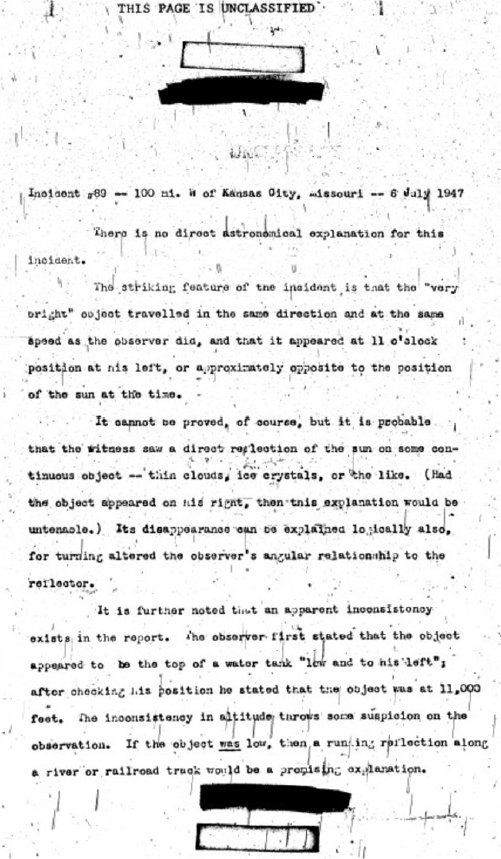
THIS PAGE IS UNCLASSIFIED
Incident n89 -- 100 mi. W of Kansas City, Missouri -- 6 July 1947
There is no direct astronomical explanation for this incident.
The striking feature of the incident is that the "very bright" object travelled in the same direction and at the same speed as the observer did, and that it appeared at 11 o'clock position at his left, or approximately opposite to the position of the sun at the time.
It cannot be proved, of course, but it is probable that the witness saw a direct reflection of the sun on some continuous object - thin clouds, ice crystal, or the like. (Had the object appeared on his right, then this explanation would be untenable.) Its disappearance can be explained logically also, for turning altered the observer's angular relationship to the reflector.
It is further noted that an apparent inconsistency exists in the report. The observer first stated that the object appeared to be the top of a water tank "low and to his left"; after checking his position he stated that the object was at 11,000 feet. The inconsistencies in altitude throws some suspicion on the observation. if the object was low, then a running reflection above a river or railroad track would be a promising explanation.
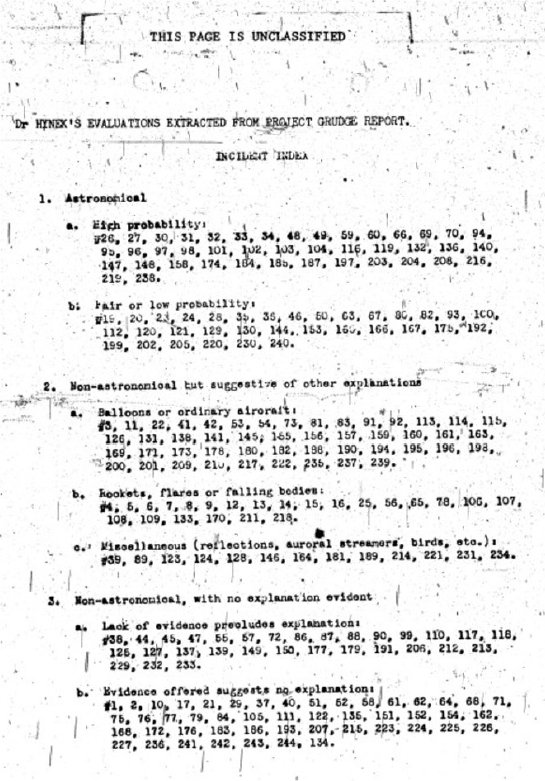
The document below indicates that at the time when Project "Sign" had been replaced by Project "Grudge", their consultant the astronomer Dr. Joseph Allen Hynek ("Dr HINEK" in the document), who was hired as consultant so that he could determine which of the sighting reports had an astronomical explanation, put this case in the category 2.c., "Miscellaneous (reflections, auroral streamers, birds, etc.)":
|
[Ref. aaf3:] U.S. AIR FORCE - PROJECT BLUE BOOK ARCHIVE:
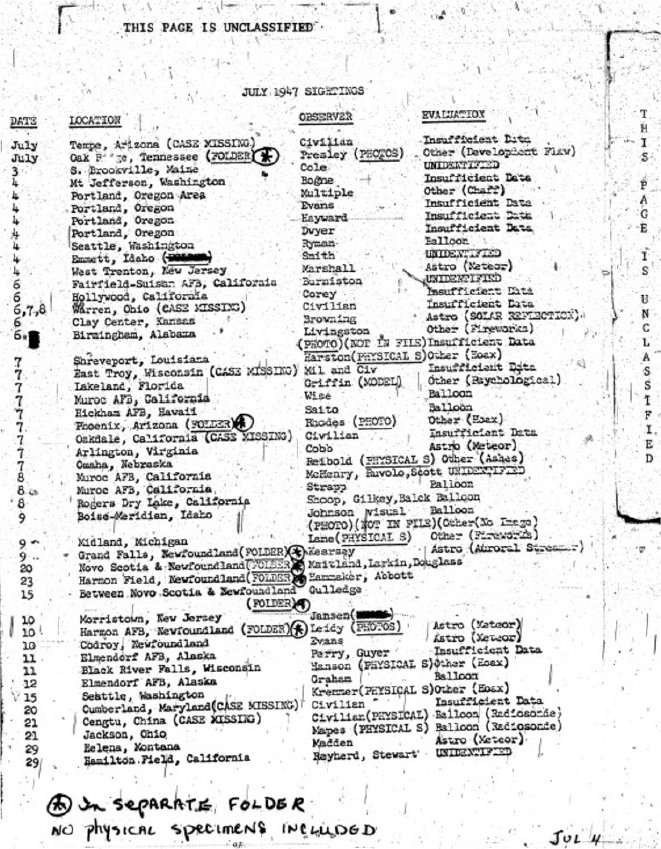
The document below, a list of July 1947 UFO sightings cases from the Air Force file, indicates that this case, July 6, "Clay Center, Kansas - Browning" had the evaluation: "Astro (SOLAR REFLECTIONS)".
|
[Ref. ert1:] EDWARD J. RUPPELT, USAF RET.:
Lieutenant - later Captain - Edward J. Ruppelt of the US Air Force, WWII veteran, was appointed head of the US Air Force UFO investigations programs "Grudge" then "Blue Book" from October 22, 1951, to about August 31, 1953.
In 1956, having left the Air Force, he published his book "The Report on Unidentified Flying Objects" in which he told the story, as he knew it and participated it, of the Air Force investigation and often clumsy or dishonest debunking of US UFO sighting reports they investigated.
In his book, one of the sightings he told about took place on July 6, 1947.
Ruppelt said the crew of an Air Force B-25 saw a bright, disk shaped object "low at nine o'clock."
Regrettably, Ruppelt gave no more information, and commented that this was one of the few reports in the Air Force file then of an object lower than the aircraft.
(This was obviously the Clay Center report.)
[Ref. tbr1:] TED BLOECHER:
Ted Bloecher indicated that on July 6, 1946, Major Archie B. Browning, Army Air Corps B-25 pilot, was flying from Ogden, Utah to Kansas City when, at 1:45 p.m. CST, near Clay Center, Kansas, he and his crew saw a bright, round, silver-colored object flying off the left wing of the plane at an estimated ten miles away. Browning was flying at 10,000 feet at the time, and the object appeared to be at a somewhat lower altitude.
Browning described the object as "disc-shaped," about 30 to 50 feet in diameter, and flying in the same direction as the B-25, eastward, in straight, level flight.
Browning said it appeared to close in to several miles of the aircraft and when he turned the B-25 toward it for a closer look, the object accelerated and disappeared at a high rate of speed.
Bloecher explains that in the Air Force files, the sighting is explained by Dr. J. Allen Hynek as "astronomical;" which leaves Bloecher wondering "how it got this assignment" as it "seems to be as puzzling as the object itself, unless, perhaps, the position of the object "at nine o'clock" was somehow confused with the time of day."
[Ref. bme1:] BRUCE MACCABEE:
| Date | Place | Local Time | Brief Description |
| 7/6/47 | Kansas City | 1345 | Major A. B. Browning AC/A3, Pentagon, saw bright, silver objects while flying at 10,000 ft. in a B-52 in CAVU weather. |
Bruce Maccabee noted that this case is found in the Project Blue Book listing ("Table of Contents") preserved in the U.S. National Archives.
[Ref. lgs1:] LOREN GROSS:

|
Kansas City, MO, July 6th: At 1:45 p.m. a Major A.B. Browning AC/A3, Pentagon, saw a bright, silver, disc-shaped object while flying at 10,000 feet in a bomber. Visibility was unlimited. 12.
The source "12" is detailed as "Flying Saucer," Minnesota, Report of Special Agent M. B. Rhodes, 18 August 48. Blue Book File #162."
[Ref. mhc1:] MICHAEL D. HALL AND WENDY CONNORS:
Only forty-five minutes later, [on July 6, 1947] at 1:45 P.M CST, an Army Air Force B-25 crew reported a similar sight during a flight from Ogden, Utah. It became one of the few incidents where a UFO was seen from above. Their plane was 100 miles west of Kansas City, Missouri, at 10,000 feet when the pilot, Archie B. Browning, caught sight of a very bright object. He described it as "shaped like the top of a water tank" - some 30 to 35 feet in diameter. Weather conditions were clear with unlimited visibility when the disc first came into view ten miles ahead and below the left side of the B-25. The UFO may have initially been hovering because as the pilot closed to within one or two miles, the disc began to parallel their eastward bound course and speed of 210 miles per hour. Browning turned toward the strange craft, which was climbing to 11,000 feet. Yet, just at that moment, it accelerated off at great srjeed and virtually disappeared. Although this report found its way into numerous Air Force files and was periodically commented on over the years, it did not receive an unidentified classification. Today the case has a notation on it attributing the event to a possible "reflection." Actually many such cases were earmarked with astronomical or meteorological explanations simply because Air Force consulting astrophysicist Dr. J. Alien Hynek, hired in 1948, would make comments to that effect on the case files he reviewed for the military. In other words, remarks of his alluding to only one possible explanation were often seized on to complete the paperwork on an open case file. It is quite true that in those early years Dr. Hynek did not believe that there was much to the disc sightings. He, in fact, felt it could all be attributed to simple "post-war nerves." But his rather careless examination of the early cases was not due to any intentional debunking on his part or conspiracy on the military's behalf.
[Ref. dwn1:] DOMINIQUE WEINSTEIN:
French ufologist Dominique Weinstein compiled a catalog of the cases of UFOs observed from aircraft. This case appears in the February 2001 (6th edition) of this catalog as:
| DATE | 47.07.06 |
|---|---|
| TIME | 13:45 |
| COUNTRY | USA |
| PLACE | Clay Center, Kansas |
| M | |
| TYPE OF PLANE AND WITNESSES | a USAAF B-25 pilot |
| UFO DESCRIPTION | a silvery circular object (diameter: 10-15 meters) |
| Radar | |
| G | |
| X | |
| E | |
| SOURCES | 336/365 03 |
The sources "336/365 03" are referenced at the end of the catalog as:
Roswell: a historical perspective (CUFOS publications 1991)
report on the UFO wave of 1947, Ted Bloecher
Project 1947 Reports, newsclippings and documents (cases from Jan Aldrich and Barry Greenwood)
[Ref. gvo1:] GODELIEVE VAN OVERMEIRE:
1947, July 6
USA, Kansas City
Commander A. B. Browning, AC/A3 Pentagon, saw at 13:45 aboard a B-42 flying at 10,000 feet a round silver disc in clear, cloudless weather. (FBI document - Bruce Maccabee, trans. Jean Sider) a round silver object 10 to 15 meters in diameter (Project ACUFOE, catalogue 1999, Dominique Weinstein)
[Ref. nip1:] "THE NICAP WEBSITE":
SIGHTINGS FROM AIRCRAFT
Preliminary Rating: 5
AVCAT is a special project being conducted by NICAP, with the help and cooperation of the original compiler of AIRCAT, Dr. Richard Haines, and other sources, to create a comprehensive listing of sightings from aircraft with detailed documentation from these sources, including Projects SIGN, GRUDGE & BLUE BOOK.
30-50' Circular Object Paces B-25, Accelerates
July 6, 1947
Clay Center, Kansas
1:45 p.m. local
Duration N/S
aircraft B-25
United States
Military
Mult Witness observers
No EMI
No radar contact
Brad Sparks:
July 6, 1947; Clay Center, Kansas (BBU)
1:45 p.m. AAF pilot Major A. B. Browning and crew flying B-25 E to Kansas City saw a silvery circular object 30-50 ft diameter pacing the aircraft at a little lower altitude then shot off at high speed heading E at 11,000 ft at 210 mph. (Project 1947; FOIA; Bloecher 1967)
Detailed reports and documents
reports/470706claycntr_report.htm (Dan Wilson) [Contains the Air Force documents.]
[Ref. fre1:] FRANCIS RIDGE - THE NICAP WEBSITE:
July 6, 1947; Clay Center, Kansas (BBU) [= "Blue Book Unknown"]
1:45 p.m. AAF pilot Major A. B. Browning and crew flying B-25 E to Kansas City saw a silvery circular object 30-50 ft diameter pacing the aircraft at a little lower altitude then shot off at high speed heading E at 11,000 ft at 210 mph. (Project 1947; FOIA; Bloecher 1967)
[Ref. tai1:] "THINK ABOUT IT" WEBSITE:
Date: July 6, 1947
Location: Clay Center, Kansas
Time: 1:45 p.m.
Summary: AAF pilot Major A. B. Browning and crew flying B-25 E to Kansas City saw a silvery circular object 30-50 ft diameter pacing the aircraft at a little lower altitude then shot off at high-speed heading E at 11,000 ft at 210 mph.
Source: Project 1947; FOIA; Bloecher 1967
[Ref. get1:] GEORGE M. EBERHART:
July 6 [1947] - 1:45 p.m. Maj. A. B. Browning and the crew of a B-25 flying over Clay Center, Kansas, see a silvery disc about 30-50 feet in diameter slightly lower than their plane. It paces them for a while then shoots off. (NICAP, "30-50ʹ Circular Object Paces B-25, Accelerates"; Bloecher, p. III-11; Sparks, p. 21)
The sources are linked to [nip1], [tbr1], [bss1].
[Ref. bss1:] BRAD SPARKS:
Brad Sparks catalogued the case of July 6, 1947, at 1:45 p.m., at Clay Center, about 100 miles West of Kansas City): the Kansas AAF pilot Major A. B. Browning and his crew flying B-25 East to Kansas City saw a silvery circular object, 30 to 50 feet in diameter pacing the aircraft at a little lower altitude then shot off at high speed heading East at 11,000 feet at 210 mph.
He indicates the sources as his contribution to "Project 1947"; FOIA documents, and Bloecher 1967.
[Ref. wia1:] "WIKIPEDIA" (EN):
| Report publish date | Location | Date of claimed sighting | Names | Notes | Bloecher # |
| Clay Center, Kansas | Jul 6 | Major A B Browning (77): 20 | #402 |
The source "77:20" is described as "National Investigations Committee on Aerial Phenomena (1997). Hall, Richard (ed.). The UFO evidence. New York: Barnes & Noble Books. ISBN 0-7607-0627-1. OCLC 39544334."
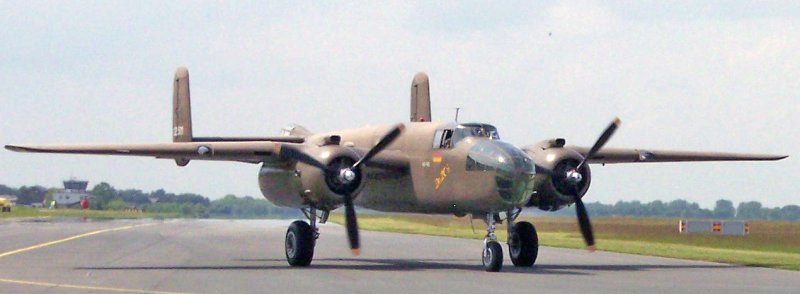
The North American B-25 “Mitchell” (photo below) was a high-performance medium bomber, used during WWII in Europe and the Pacific by the U.S. Army Air Forces.
Its crew was normally 8 men, its range was 2,170 km, its defensive armament was, depending on the versions, from 2 to 18 12.7 mm caliber machine guns.
|
The minimum crew to fly a B-25 safely is 2 pilots, the full operational crew is usually 4-6 people, minus 2-3 gunners in peace time.
It is therefore quite likely that there were at least two witnesses, if not more.
The standard USAAF B-25 "Mitchell" bomber did not normally carry airborne radar. Exception existed but only in the US Marines corps and some tests projects.
|
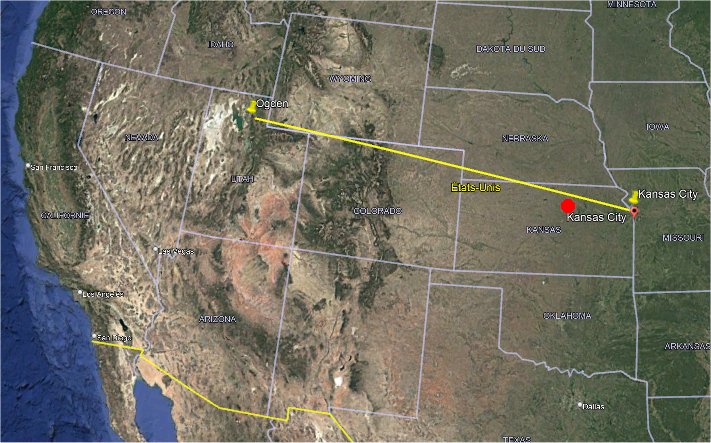
The B-25 flight was from Ogden, Utah, to Kansas City, Missouri, a route of approximately 1,400 kilometers as the crow flies. The report indicates that the sighting took place about 100 miles west of Kansas City, placing it over Clay Center, Kansas.
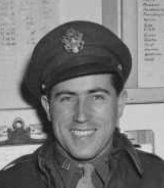
|
About the witness:
Archie Basil Browning (photo above) was born in Annis, Idaho on September 23, 1919. He graduating from the University of Idaho Southern Branch, then joined the Army Air Corp as a cadet. He received his wings at Luke Field, Phoenix, Arizona, February 5, 1942. He received extensive training as a B-17 and B-24 bomber pilot at Geiger Field, Spokane, Washington. In September 1942, he flew to Australia as flight commander of a B-24 crew. While in the South Pacific, he flew 44 combat missions. His plane was shot up and badly damaged on several of the missions.
One experience as told in the Flying Buccaneers by Doubleday, had a direct effect on the outcome of the war. In March, 1943, his crew spotted and helped destroy a 22 ship Japanese convoy en route to Australia. During the encounter, he lost his navigator and gunman, but was instructed by the 5th bomber command to stay in the target area, report convoy movements and assist the 1st B-17's to the target. Eventually, most of the convoy was destroyed.
He returned to the states in late 1943 with several medals including the Air Medal and Distinguished Flying Cross. His squadron, one of the first to go overseas during World War II had a casualty rate of nearly 90%.
The context:
A good read about this topic is chapter II of Capt. Edward Ruppelt's book.
An interesting bit is:
If the confusion in the minds of Air Force people was organized the confusion in the minds of the public was not. Publicized statements regarding the UFO were conflicting.
A widely printed newspaper release, quoting an unnamed Air Force official in the Pentagon, said:
"The "flying saucers" are one of three things:
A follow-up, which quoted several scientists, said in essence that the unnamed Air Force official was crazy. Nobody even heard of crystallized meteors, or huge, flat hailstones, and the solar reflection theory was absurd.
The sighting:
I explained in the Summary that a misinterpretation of the report led to a highly questionable evaluation of this case by the U.S. Air Force.
How could one believe for a second that, after mistaking an ordinary reflection on a river or a railroad track for something unusual, an experienced pilot would have taken his eyes off it for 5 seconds, and then seen another thing that he would again have considered out of the ordinary, this time in the sky?
It should also be noted that while the object, at first, when it was lower than the aircraft, was estimated to be 10 miles away, when it was higher than the aircraft it was 1 to 2 miles off the left wing, under excellent visibility conditions.
And this would have been a cloud, or ice crystals, or "something else," "reflecting the sun"? The aircraft was flying at 210 miles per hour, and the thing was flying at the same speed, the pilot tells us. At the aircraft's speed, if this thing had been a cloud, a balloon, or "something else," they would have overtaken it very quickly at that distance. And if the distance was greater, then the thing was correspondingly larger.
The idea that the "sun reflection" would have disappeared because the aircraft was then turned toward that reflection does not hold up. A balloon or a cloud would reflect sunlight in the same way from the side as from the front because these are not flat bodies, like mirrors, producing a unidirectional reflection. And one must also accept the notion that a cloud or ice crystals in sunlight "reflect" the sun, whereas sunlight would merely illuminate them. Yet the pilot stated that the brightness of the object was very intense ("The brightness of the object was very intense").
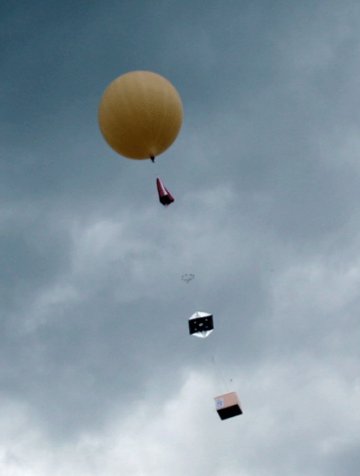
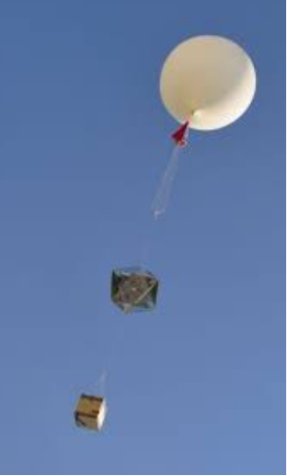
This would have required a silvered, reflective Mylar balloon; but none existed in 1947. Balloons were made of latex or neoprene, white or light gray or beige, and matte. They did not reflect sunlight. The sun could only illuminate them normally. And one would also have to assume that Major Browning had no knowledge whatsoever of the existence of balloons. An ordinary reflection on a river, yes; a reflection on a cloud, balloon, or ice crystals that disappears and is described as "very bright," no.
|
|
Possible extraterrestrial craft.
* = Source is available to me.
? = Source I am told about but could not get so far. Help needed.
| Main author: | Patrick Gross |
|---|---|
| Contributors: | None |
| Reviewers: | None |
| Editor: | Patrick Gross |
| Version: | Create/changed by: | Date: | Description: |
|---|---|---|---|
| 0.1 | Patrick Gross | June 7, 2026 | Creation, [aaf1], [aaf2], [aaf3], [tbr1], [bme1], [lgs1], [dwn1], [gvo1], [nip1], [fre1], [tai1], [bbs1], [get1], [wia1]. |
| 1.0 | Patrick Gross | June 7, 2026 | First published. |
| 1.1 | Patrick Gross | June 28, 2026 | Addition [mhc1]. |
| 1.2 | Patrick Gross | July 5, 2026 | Addition [ert1]. |